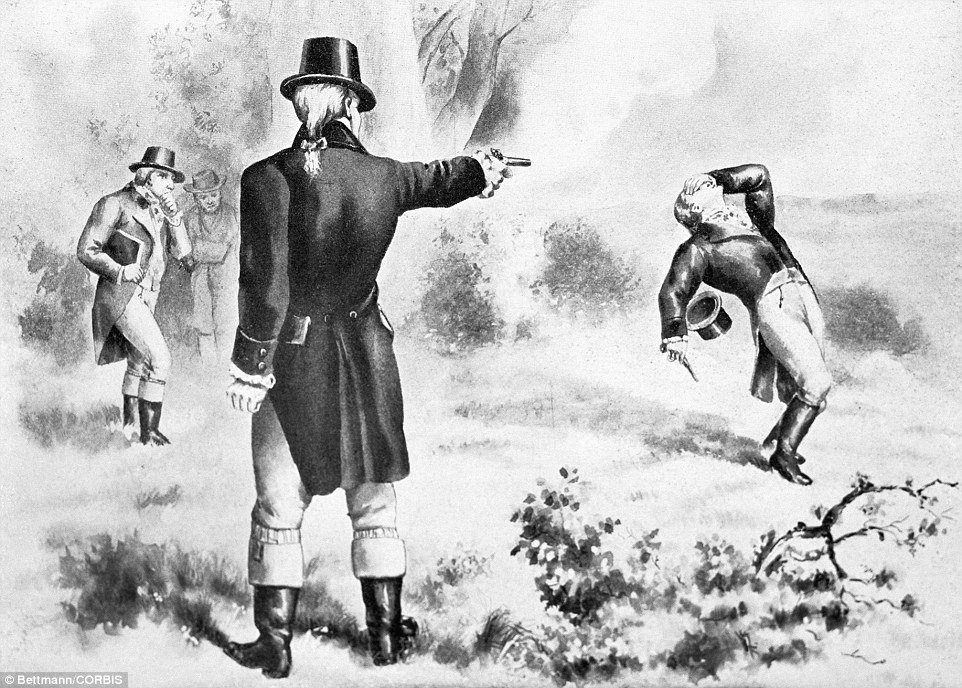
When we talk about duels in early American history, one confrontation looms largest: the fatal meeting between Alexander Hamilton and Aaron Burr. Yet, to truly grasp the profound impact of that tragic July morning, we must first look three years earlier, to The Philip Hamilton Duel and Its Impact. It was on that same blood-stained ground in Weehawken, New Jersey, that Alexander Hamilton's eldest son, Philip, fell in defense of his father's honor, setting a precedent that would ultimately dictate Alexander's own tragic decision.
This isn't just a story of political rivalry gone too far; it's a deep dive into a cultural phenomenon, a father's grief, and the rigid code of honor that could demand a man's life.
At a Glance: The Hamilton-Burr Duel in Brief
- A Fatal Encounter: On July 11, 1804, Alexander Hamilton and Aaron Burr met in Weehawken, New Jersey, a duel spurred by a decade-long political rivalry and escalating insults.
- The Code of Honor: Duels were formal rituals, not brawls, designed to defend or redeem a man's reputation, which was vital for public leadership. Most did not end in death.
- Hamilton's Dilemma: Despite moral objections, legal risks, and family concerns, Hamilton accepted the challenge, fearing refusal would destroy his public standing and political viability.
- A Son's Shadow: The duel took place at the same site where Hamilton's eldest son, Philip, had died in a duel three years prior, defending his father's honor.
- Tragic Outcome: Burr's shot fatally wounded Hamilton, who died the next day. Hamilton had reportedly intended to "throw away" his shot.
- Burr's Ruin: Public outcry and murder charges forced Vice President Burr to flee. Though later acquitted of treason, his political career was effectively over.
- A Nation's Turning Point: Hamilton's death accelerated the decline of dueling in the North, contributing to its eventual disappearance as a social custom across the country.
The Code of Honor: When Reputation Was Everything
Imagine a world where your entire public life—your standing, your career, your very suitability for leadership—hinged on an intangible quality called "honor." For gentlemen in 18th and 19th century America, particularly in political circles, this was not just a concept; it was a driving force. Losing face, allowing an insult to stand, or being perceived as a coward could utterly dismantle a man's future.
This is the bedrock upon which the practice of dueling rested. These weren't spontaneous, emotion-fueled brawls. Instead, duels were highly ritualized "affairs of honor," governed by strict protocols. The goal wasn't always to kill your opponent; often, it was simply to prove your willingness to die for your honor. Many political duels ended without bloodshed, or with non-fatal wounds. For instance, Alexander Hamilton himself had been involved in ten prior "bloodless" affairs of honor before 1804. The ritual itself, the willingness to face death, was often enough to satisfy the demands of honor.
So, when insults flew, especially in the cutthroat world of early American politics, a duel was often seen as the only path to maintain one's standing.
A Rivalry Forged in Fire: Burr vs. Hamilton's Long Feud
The fatal duel between Hamilton and Burr wasn't a sudden explosion but the culmination of a political rivalry that had simmered for over fifteen years. Their antagonism wasn't just philosophical; it was intensely personal, with each man frequently undermining the other in public and private.
Their differences stretched back to at least 1791, when Aaron Burr successfully challenged and defeated Philip Schuyler, Alexander Hamilton's influential father-in-law, for a New York state senate seat. This early political victory for Burr was a direct affront to Hamilton's family and influence, deepening a nascent rivalry. Over the years, their clashes intensified, fueled by differing political ideologies—Hamilton, a staunch Federalist advocating for a strong central government; Burr, a more pragmatic Republican often seen as an opportunist by his critics. Their paths crossed, and often collided, at every turn of New York and national politics.
The Breaking Point: Slanders, Challenges, and Crossed Wires
The spring of 1804 brought this long-standing animosity to a head. Aaron Burr, then the sitting Vice President, made a bid for the governorship of New York. However, his campaign was derailed, in no small part, by the fervent opposition of Alexander Hamilton. Hamilton saw Burr as a dangerous demagogue, unfit for public trust, and he campaigned vigorously against him.
Following Burr's loss in the gubernatorial election, a newspaper clipping surfaced in April 1804 that would serve as the immediate catalyst for the duel. It quoted Hamilton at a dinner party, making scathing remarks about Burr, calling him a "dangerous man, and not to be trusted." Worse, it referenced an even "more despicable" opinion Hamilton allegedly held. For Burr, this was the ultimate public humiliation, an attack on his character and honor that could not be ignored.
The protocol for an "affair of honor" would then commence: the insulted party (Burr) would send a letter requesting an explanation or a retraction. Communication would typically go through "seconds," trusted friends who acted as intermediaries, delivering letters and attempting to negotiate an apology that would appease both parties and restore honor without resorting to violence. Hamilton had been through these exchanges before, successfully deflecting them.
However, this time, negotiations went awry. Burr felt profoundly dishonored and, as the back-and-forth escalated, demanded an apology for all of Hamilton's insults over their entire fifteen-year rivalry, not just the recent newspaper comments. Hamilton, ever stubborn and convinced of his political principles, refused, stating he "meant them." With no path to reconciliation and honor seemingly irretrievable, Burr had one option left: he challenged Hamilton to a duel. And Hamilton, despite his internal conflicts, accepted.
Alexander's Agony: The Impossible Choice of Honor and Principle
Why would a man as brilliant and influential as Alexander Hamilton, a former Secretary of the Treasury and a leading mind of the young republic, accept a duel that so clearly went against his better judgment? His reasons were complex, a torturous calculus of personal morality, public duty, and the rigid demands of his era.
Hamilton had significant reasons to avoid the duel:
- Moral & Religious Principles: He privately wrestled with the conflict between dueling and his deeply held religious and moral convictions.
- Legal & Family Threats: Dueling was illegal, and accepting the challenge threatened his family's welfare (especially his wife Eliza and their numerous children, including Explore Angelica Hamiltons life) and his creditors, as he was in considerable debt.
- Little Gain, Much Hazard: He saw little personal gain in the encounter, only immense risk. He also claimed no personal ill-will towards Burr, describing their differences as purely political.
However, Hamilton believed refusing the challenge would destroy his reputation and career. In his eyes, it would be "political suicide." He felt compelled to preserve his public standing and viability as a leader for potential future crises in public affairs. For Hamilton, maintaining this public standing was inseparable from "conformity with public prejudice" regarding honor. To be branded a coward, to be seen as unwilling to defend his honor, would render him useless in the political arena he so deeply valued. The weight of societal expectation, of what it meant to be a "gentleman" and a leader, ultimately outweighed his personal objections.
Weehawken's Fatal Dawn: A Son's Echo, a Father's Fate
The dawn of July 11, 1804, found Alexander Hamilton and Aaron Burr crossing the Hudson River to Weehawken, New Jersey. This site was strategically chosen because dueling penalties there were less severe than in New York. But for Hamilton, the location held a more profound and agonizing significance: it was the very same spot where, just three years prior, his eldest son, Philip, had tragically lost his life in a duel.
Philip, a bright and promising young man, had dueled to defend his father's honor against a political opponent, George Eacker, who had publicly slandered Alexander Hamilton. In a heart-wrenching parallel to his father's later actions, Philip too had reportedly intended to "throw away" his shot, only to be struck down. The memory of The Philip Hamilton Duel and Its Impact must have weighed heavily on Alexander's mind as he stood on that same rocky ledge, contemplating his own fate.
Accompanied by their seconds—Nathaniel Pendleton for Hamilton and William Van Ness for Burr—and Dr. David Hosack, the two men faced each other. Hamilton had stated his intention to "reserve and throw away my first fire," meaning he would deliberately shoot wide, demonstrating his lack of intent to kill and hoping to satisfy Burr's honor without bloodshed.
Two shots were fired within seconds. The exact sequence of events, and who fired first, remains a subject of historical debate. What is clear is that Hamilton's shot went wide, striking a tree several feet above Burr's head. Burr's bullet, however, found its mark, striking Hamilton in the abdomen, piercing his liver and lodging in his spine. Alexander Hamilton fell instantly.
The Aftermath: A Nation Stunned, Lives Upended
The duel at Weehawken sent shockwaves across the young United States. Alexander Hamilton, one of the nation's most brilliant founding fathers, a principal author of the Federalist Papers, and a visionary architect of America's financial system, was mortally wounded. He was transported back to Manhattan and died the next day, July 12, 1804.
For Aaron Burr, the immediate aftermath was catastrophic. Despite his elite status (political leaders were rarely punished for dueling, as it was understood as an affair of honor), public outcry was immense. He was accused of being a merciless killer and charged with murder in both New York and New Jersey. The Vice President of the United States was forced to flee, seeking refuge in South Carolina and going into hiding. While he would later be acquitted of treason charges in 1807, the duel had effectively ended his illustrious political career. He spent years in self-imposed exile in Europe before returning to New York to practice law, deeply in debt, eventually dying in 1836.
Hamilton's death also left his family in a precarious position. He died deeply in debt, owing approximately $55,000. His wife, Eliza, and their children faced financial ruin and the potential loss of their beloved estate, The Grange. However, in a testament to Hamilton's enduring friendships and influence, a secret subscription fund was raised by "Gentlemen of Fortune." These benefactors purchased The Grange and then sold it back to Eliza at half-price, allowing her and the children to remain in their home for decades, a small measure of comfort amidst their profound grief.
A Legacy Redefined: The Duel's Enduring Impact on America
While dueling was already on the decline in the Northern states prior to 1804, Alexander Hamilton's death dramatically accelerated its fall. The sheer magnitude of losing a figure of his stature to such a "barbaric" practice sparked a significant anti-dueling outcry. Public sentiment shifted more decisively against the practice, viewing it less as a noble defense of honor and more as a reckless, destructive act.
However, the practice of dueling didn't disappear overnight. It lingered in the North for some time and continued to thrive in the South for many decades after 1804, gradually becoming viewed more as a "Southern custom." It wasn't until the first half of the nineteenth century that dueling finally died out across the entire United States, largely due to changing social norms, stricter laws, and the powerful moral argument solidified by events like the Hamilton-Burr duel.
Hamilton's death solidified his place as a martyr for the Federalist cause, even as his party faded. His vision for American governance and finance, however, lived on, forming the bedrock of the nation's economic system. The duel served as a stark reminder of the dangers of unchecked political rivalry and the destructive power of a rigid honor code.
Beyond the Bullet: What We Learn from History's Tragic Duels
The story of the Hamilton-Burr duel, deeply intertwined with The Philip Hamilton Duel and Its Impact, offers more than just a dramatic historical narrative. It's a window into a past where personal honor held sway over life itself, shaping the decisions of even the most formidable leaders.
From this tragic tale, we can glean several lasting insights:
- The Power of Reputation: In any era, how we perceive and protect our reputation matters. The Hamilton-Burr duel highlights an extreme version of this, reminding us how crucial trust and public perception can be, particularly in leadership.
- The Perils of Unchecked Rivalry: While political debate is vital, the Hamilton-Burr saga shows the destructive potential of allowing differences to devolve into deep-seated, personal animosity.
- The Evolution of Society: The eventual decline of dueling after Hamilton's death demonstrates society's capacity to evolve, to reject practices once considered acceptable when their true costs become undeniable.
- The Weight of Precedent: For Alexander Hamilton, his son Philip's duel served as a grim precedent. It underscored the societal expectation that a man must defend his honor, even at the cost of his life. This tragic echo resonates, reminding us that the decisions of those who came before can profoundly shape our own paths.
Ultimately, the duel at Weehawken wasn't just a clash of two titans; it was a pivotal moment that forced a young nation to reconsider the values it held dear, pushing it toward a future where reasoned discourse, not pistols at dawn, would settle its disagreements.